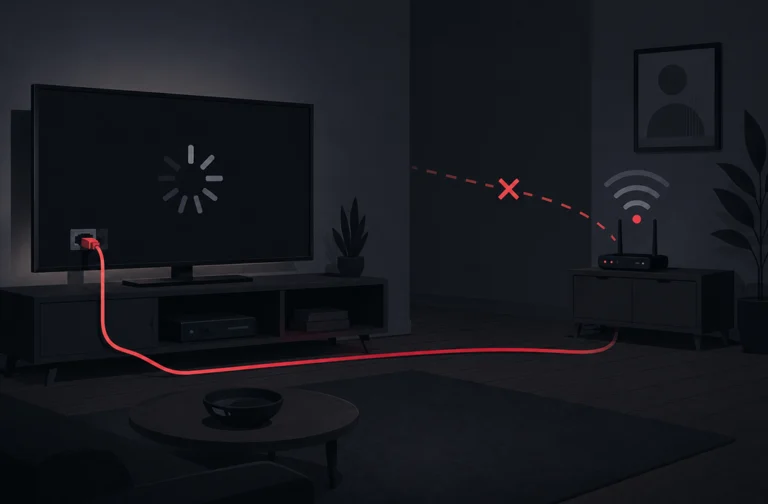
Why Your United Kingdom IPTV Keeps Buffering and How to Stop It
You are settled onto the sofa, the premium sports match is about to kick off, and suddenly—the spinning wheel of doom appears on your screen. Severe buffering, playback stuttering, and sudden audio drops are the ultimate enemies of a great television experience.
The good news is that the vast majority of streaming interruptions are completely unrelated to your actual IPTV subscription. Instead, they are usually triggered by minor local network issues that you can easily optimize yourself right from your living room. This technical diagnostic guide walks you through the most common root causes of stream latency and details exactly how to configure your system for a smooth, high-definition viewing experience.
Optimize Your Local Network Before Blaming Your Provider
Before assuming there is a major server issue with your United Kingdom IPTV network, it is essential to evaluate the health of your home broadband connection. Wireless signals are highly susceptible to electromagnetic interference from thick brick walls, neighboring routers, smart home appliances, and even baby monitors.
If your primary broadband router is placed in a hallway or a front room while your main Smart TV or streaming device sits at the back of the property, the wireless data packets must travel through multiple physical obstacles. This structural distance degrades your network throughput, resulting in micro-disconnects that trigger the player app’s loading wheel. Shifting your equipment or adjusting its internal settings frequently remedies the lag instantly.
Why an Ethernet Cable Connection Beats Wireless Every Time
While wireless streaming is highly convenient, a physical hardwired link remains unmatched for heavy data transmission. Connecting an Ethernet cable directly from your broadband router to your Smart TV, Firestick, or media receiver completely eliminates local signal interference.
A wired link guarantees steady, continuous data speeds and entirely prevents the bandwidth dropouts that occur when multiple wireless devices compete for a single signal. If your streaming box is positioned near your router, investing a small amount in a high-quality Cat6 Ethernet cable is the single most effective way to protect your
IPTV UK feeds from localized buffering problems.
Perform a Routine Network Router Power Cycle
Home routers function as small dedicated computers. Over time, their internal cache memories become clogged with data routing tables, background device handshakes, and temporary operational logs, which eventually causes their processing speeds to become sluggish.
A simple weekly power cycle completely flushes the router’s temporary memory blocks and resolves the vast majority of transient network glitches. To perform this correctly, completely unplug your router from the wall mains, wait a full thirty to sixty seconds for the capacitors to drain entirely, and plug it back in. This basic maintenance step clears technical conflicts and boosts overall download performance for your entire British IPTV network.
Manage Household Bandwidth Allocation and Connected Devices
If a household member is actively downloading large media updates, running online gaming consoles, or streaming 4K video feeds on another television, your media player application may struggle to secure the necessary data packets. Standard residential broadband packages often face strict bandwidth limitations when trying to process multiple high-demand streams at the same time.
To maximize stability during important live broadcasts, try pausing heavy background downloads on other connected appliances, or log into your router’s administrative control panel to activate Quality of Service (QoS) protocols. This configuration allows you to explicitly prioritize your primary streaming media hardware over other household data traffic.
Identifying Server-Side Interruptions During Peak Events
While rare on high-performance networks, there are instances where buffering stems directly from server-side load limitations. This typically occurs during massive, highly anticipated live global sports events when millions of viewers simultaneously request the exact same stream routing.
A top-tier, resilient United Kingdom IPTV architecture is specifically engineered with heavy server load balancing to minimize these occurrences. If you encounter a localized server-side choke point during a major broadcast, the best course of action is to wait a brief moment for the automated load balancers to redistribute the traffic, or simply use your application menu to switch to an alternative backup stream channel feed.
Immediate Troubleshooting Steps to Resolve Buffering Right Now
If you are caught in an aggressive loading cycle during a live broadcast, implement these immediate troubleshooting steps in sequence: First, access your media player’s settings panel and adjust the stream output quality from 4K to Full HD. Next, hard-close the application to flush the application cache, and restart your streaming stick.
If the loop persists, reboot your main broadband router. Finally, consider testing your connection profile on an alternative player application. Certain software architectures manage shifting data packets much more efficiently than others, ensuring your premium IPTV subscription remains completely stable.
The Bottom Line on Smooth Playback
The reality of modern digital entertainment is that the majority of streaming lag starts right inside the consumer’s home network. By transitioning to a wired connection, keeping your router’s memory freshly cleared, and managing household data hogging, you can easily eradicate nearly every common buffering issue.
If you have executed these internal home optimizations and still encounter persistent streaming drops, it is time to contact our dedicated support specialists via WhatsApp. Our backend engineers can instantly analyze your connection line to verify server parameters and help you secure the ultra-smooth viewing experience your subscription is built to deliver.